Day 359
Astra GPT 6.0: What Do You Actually Need It For?
A new ChatGPT model has arrived: Astra, or GPT 6.0. I have become so used to this cycle that every day I open my Telegram and Twitter subscriptions and almost everyone is writing the same thing: a new model is out, here are its parameters, here are its benchmarks, and so on.
Today I decided to speak to you by voice. We live in an era where a huge amount of content passes through AI, and honestly, I am already a little sick of its familiar patterns, especially when I work with AI from morning until night. Sometimes real communication, even without perfect structure, bullet points, and every comma in place, feels more pleasant and more valuable. So I want to share my view of Astra and all the other models around it.
The main question is how you can use such a model in your own project. There is a gulf between a model and its surrounding machinery. There is the model itself, and then there is the system and infrastructure in which it works. If you simply open a chat, ask a question, or request an explanation or some research, I think the difference for an ordinary user is now very small: whether it is Astra, GPT 5.6, or GPT 5.5, all of them can produce excellent results at the level of a normal chat.
My project has now reached a stage where I do not feel a strong need for an even smarter model. The main bottlenecks are no longer in the model's intelligence. They are scattered across a huge number of processes, small refinements, and the general chaos of a growing system.
Imagine a car. The engine is the model; the complete car is the system into which you install that engine. If you replace a 1.6-liter engine with a 1.7-liter one, will every performance measure immediately improve? Of course not. Even a good engine inside a badly configured car will work poorly or fail to deliver the result you expected.
With AI, the fundamental word is “system.” This is the enormous invisible iceberg that most people do not see. The environment you build around a model often matters more today than the model itself. You can take an older model, place it in the right environment, and receive a more useful result.
We live in a world of systems. A person is a system. A car is a system. A road is a system. A university is a system. Something enters it: data, people, or values. Transformations happen inside, and something comes out. Simply replacing one AI with another will do very little if the system itself does not change.
In my case, the system contains many separate units: agents. Every agent also has its own small system with responsibilities, environment, directory, tools, permissions and limits, verification mechanisms, and prepared sets of instructions. A repeated task has a skill that explains what to do, what not to do, what the objective is, which tools to use, which branches may appear, and how to handle them. One agent may have two or three such skills, or it may have fifty.
Now imagine a new model inside that construction. Around it are many agents, instructions, and incoming data streams. The data is processed, stored, routed into other blocks, and processed again. Modules interact with one another. Above them sits a broader supervisory picture. Such a system can scale to hundreds or thousands of agents. The central question is no longer the model's name, but how effectively the vertical and horizontal relationships have been designed.
That is why replacing every model across a project with a single command is wrong and inefficient. Some tasks need a simple, fast model. Resources are not infinite: even a Pro subscription quickly reaches its limits, and when you work through an API or a corporate environment, cost accounting becomes even more important.
You do not need a PhD to send a cat to the shop for bread. That is the point. Most project tasks do not need the most powerful available model. For an ordinary person who is not building this kind of factory, the difference between Astra and another strong model may be almost invisible.
If you want to build something with AI that is more substantial than a simple Telegram bot converting PDFs into another format, the first thing to examine is the infrastructure.
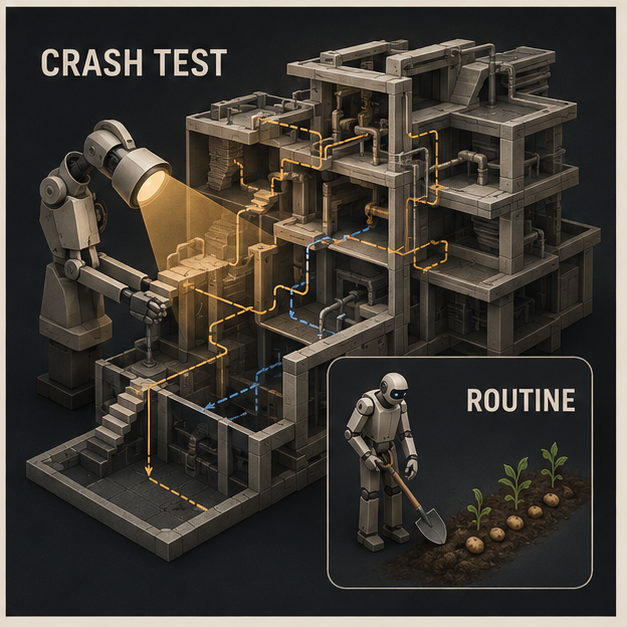
So where are models at Astra's level genuinely useful? At the level of the whole system. Their value appears when a complex digital structure, whether a site, a service, an architecture, or many connected modules, must be investigated deeply, persistently, and from many angles. Such a model can probe the system from different sides, find small vulnerabilities, try increasingly sophisticated tests, and stay with the problem for hours, days, or weeks. In effect, it can run a crash test on another complex system.
It is unnecessary for smaller tasks. You do not need it for ordinary coding: Sol and GPT 5.5 already handle that very well. But if you are designing a complex architecture, searching for errors or vulnerabilities, looking for alternative paths, unconventional solutions, or hidden patterns, then yes, this level of intelligence may be justified.
Sending it to do simple work is just a waste of resources. It is like asking a Nobel laureate to dig potatoes in your garden simply because you can. It may occasionally be entertaining, but it is almost never efficient.