Day 366
One Year Building an AI Startup Alone
A year has passed since I began working alone on a project meant to give funds more clarity about what to do with options, how to hedge the market, and how to avoid getting caught in crashes. I decided to speak about the psychological side in free form, without notes or prepared points, because for me this has been, and still is, a phenomenal experience.
Two years ago I sincerely believed that one person could build a technology startup without a technical background or knowledge of software development. There were about six months of preparation and writing code with AI before this year began. I entered it with an understanding of my advantages: what I know about markets, trading, investing, funds, and how crypto works. I wanted to bring all of that into one product that could live, generate income, and operate with enough independence.
It was a year of hard trials. There were many dead ends, frustrations, and periods of burnout, together with enormous intellectual growth. I had previously managed a company of around 50 people, where my job was to make decisions. Here I was alone, and at first I thought that this would not be so difficult.
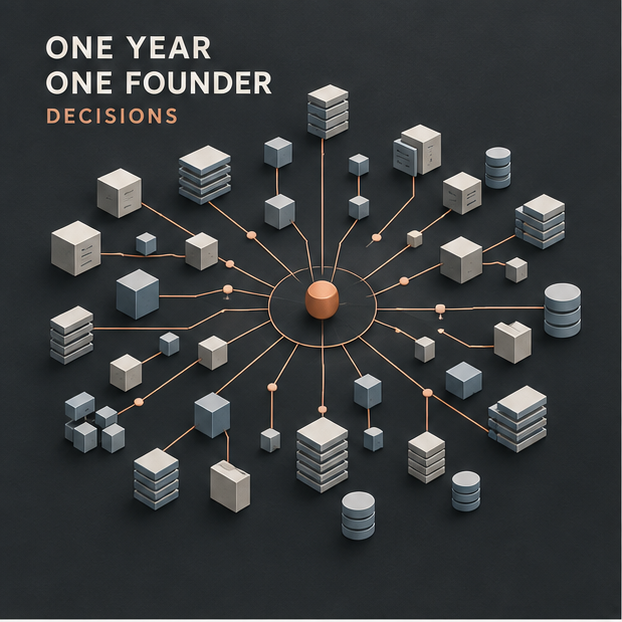
The hardest part turned out to be something else. I have to work through a huge number of scenarios in parallel, make decisions quickly, learn, understand what works, draw conclusions, adapt, and keep moving. As artificial intelligence developed, the level of decisions that had to be made all the time only increased. A year ago I had one vision of the project. Honestly, I did not imagine that today it would have this form, scale, and structure.
Work with B2B clients has only just begun. There are also several retail clients who have been with me for a year or even longer, and I am very grateful for their support and feedback. Before the first B2B clients appear, it feels for a long time as if you are working in a vacuum, because the outside world gives almost no response.
Every next iteration became more complex, ambitious, and multi-layered. About every two to four weeks I reached my limit, lay down, looked at the ceiling, and tried to enjoy the moment when my head was empty. On weekends I could spend the whole day watching films and series. Sometimes I went into nature, sat on a folding chair near trees or the sea, and simply looked for hours. It helped a lot.
Today I do high-level architecture work, product management, engineering, design, and client communication. I had some experience in almost every one of these areas, which is why I took on this structure. AI allowed me to remove the technical barrier and bring into one project what had previously been spread across different fields.
I wanted to make real what was in my head. Even if I had hired a development team, I would have needed to stay in the same room with them all the time: an idea appears, we discuss it, immediately run tests, see whether it works, and decide where to go next. With AI agents, that cycle runs every day. Voice chat with ChatGPT made the work a little easier. When I get tired of long texts and structured answers, I put on headphones, step away from the computer, and literally talk with my project.
The project is available to me from my phone, server, and computer. The computation runs on the server, and 25 agents manage the processes. Automation exists at almost every step, although it is still far from ideal. Some things are already well developed, and much remains to be done.
Interest in a new hypothesis often collided with reality. It turned out that there was nothing unique in it, dozens of analysts had already tested it, the research was sitting in archives, and there was no golden Grail or ready competitive advantage. Over ten years I accumulated many ideas about markets and trading, and during this year I tried almost everything: different indicators, Smart Money, and other approaches. Nothing works simply and consistently. There are separate small pieces from which a logic can gradually be assembled.
An idea appears like a flash, and then it needs a long period of finishing. At first it seems that you can simply launch AI agents and receive the result. Nothing creates itself. AI requires constant correction, while the smartest models can burn huge quantities of tokens with little practical result. Setting the goal is critical, although often you still do not know what the final result should be or what success looks like exactly.
You have to make hundreds of iterations and search for a compromise. If you watch every agent, you cannot scale. If you hand over the entire process, it turns into a black box. You launch five, ten, or twenty such processes and gradually see repeated errors, deviations, and places where control is needed again.
Before Astra was released, I thought the new model would help me quickly untie the difficult tasks that had accumulated. The bottlenecks increased. The model became stronger, and with that it became less predictable. It can disappear into endless checks, loops, internal hypotheses, and research, while the efficiency of every next round falls. An impressive test result says little about practical use until you see how many hours, agents, computations, and dollars were required to produce it.
The arrival of new models does not make people useless. Some things become possible, while solving one problem opens two or three more. The system becomes more complex and the number of failure points grows, so human control remains critical. In my own work I regularly see a model ignore an instruction or drift into a task that I never gave it. That is already enough to treat autonomy without romance.
The scale of my current work is roughly equal to a team of 40 to 50 developers. For one person, this is already close to the boundary of what can be controlled. You need to understand where everyone is moving, where a fork has appeared, and what decision is required. This is why I am building a separate operating system to manage the project. An ordinary task board does not solve the problem here, because the tasks themselves are narrow and carried out by agents. The human needs plain language, correct classification, and a way not to spend the whole day manually maintaining that system.
During this year I grew enormously, technically and intellectually. I began to see structures, sequences, and connections differently. Sometimes I look at ordinary processes in life and see a tree, layers, and flowcharts. It is interesting, it develops you, and it was definitely worth the path. The path was not easy.
The long absence of financial flow also creates pressure. You build, spend, build again, and the reserves gradually run down. At every fork you ask yourself whether you are going in the right direction. There is another concern: tomorrow a large AI company may release a native function that covers 80 to 90 percent of the needs more cheaply and accessibly.
A systematic repeating cycle helps me continue. Books, physical exercise, morning rituals, a clear daily schedule, and mutual support with my wife. Then you look back and realize that summer passed almost unnoticed in the outside world, while inside the project an enormous amount changed during those months.
That is how the year passed. Did I think that after a year I would be in roughly this position, with this result? No. I expected more financial results, while I did not imagine that the project itself would become what it is today.
The next year will be even brighter. May the Force be with us!