Day 372
An Interface for Making Decisions
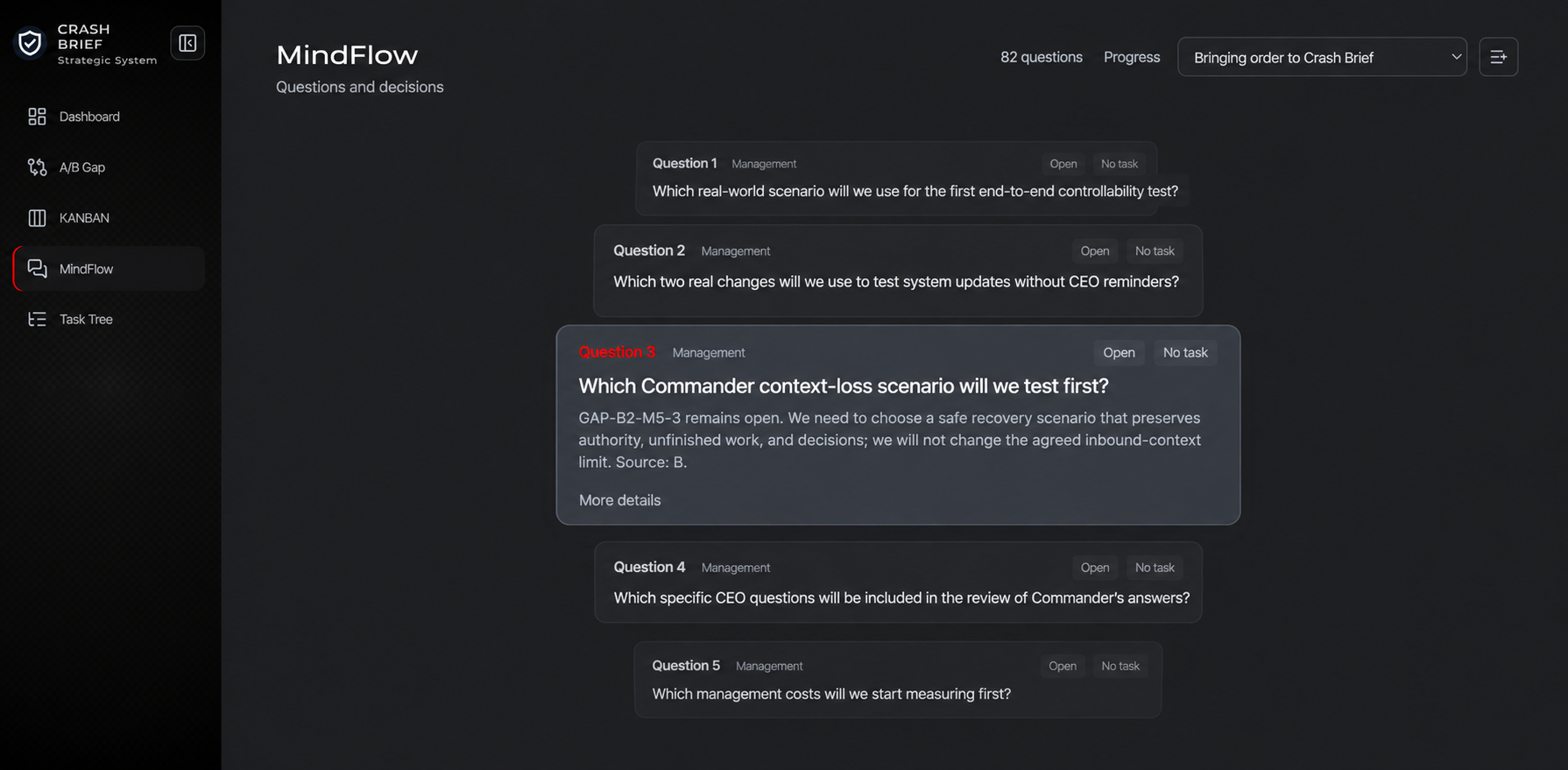
As I clear the mess in the project and try to organize all the processes so they converge on one central managing agent, a huge number of questions, branches, and decisions appear.
And honestly, every time there are two options.
You can give AI all the necessary context, explain the architecture, limitations, skills, your own taste, and ask it to make the most optimal decision.
It is fast, but afterward there is always a surprise.
You do not know in advance exactly how it will implement everything. Even a person can do the same task in three different ways under different circumstances. It is the same with AI, except that it also builds everything for itself, for a machine-readable format.
And then, if you let a person into a database created by AI, sometimes you can simply break a leg there.
Everything seems to work. But to find some function, understand why the decision was made exactly that way, and how it is connected with everything else, you have to figure it out again almost from zero.
And here I constantly run into the same obstacle.
To move faster, I need to take as many tasks off myself as possible and delegate them to AI. But to remain the owner of the system and understand what is happening inside it, I still need to make the important decisions myself.
Today I was going through a huge number of questions that appeared after yesterday's audit, and it struck me that I need another way to work with such decisions.
A large task always has many subquestions. How this should be arranged. Where something else should point. How everything should interact. What matters, what can be postponed, and what is not needed at all.
And these are already management decisions that a person must make.
AI has no motivation of its own. It will not push the system all the way to a result by itself simply because it needs that result for some reason. A person still has to set the direction.
So I decided to make a small mini-service inside my strategic system.
It will connect a visual representation, a checklist of questions, and the final decision.
For example, we discuss question number five with my main agent. We make a decision. It is immediately recorded and appears visually in the architecture. After that, the selector moves to the next unresolved question.
In this way, I want to participate more in my own project, but do it more systematically and conveniently.
And most importantly, I want everything to be visible to the eye, not only written somewhere in another JSON file.
It works like this: you load a list of tasks that need to be discussed, turn on voice mode, and move through the questions with an assistant that records the decisions.